Science Allemagne met en lumière le projet « Femmes scientifiques / Wissenschaftlerinnen : Portraits croisés »
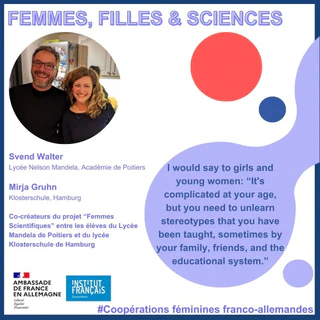
Publication Science Allemagne (6 mars 2024) et mise en avant sur LinkedIn.
Lire l'article sur Science Allemagne
The office for Science and Technology of the French Embassy in Germany puts the spotlight on women in science as well as in project management, particularly Franco-German scientific collaborations involving women and girls, in order to contribute to the International French strategy for a feminist diplomacy 2025-2030 (Stratégie internationale de la France pour une diplomatie féministe (2025-2030) et Diplomatie féministe : accélérons la mobilisation
Mirja Gruhn, a teacher at Klosterschule High School in Hamburg, and Svend Walter, a teacher at Nelson Mandela High School in Poitiers, answered our questions. Find the full interview here: https://www.science-allemagne.fr/diplomatie-scientifique-feministe/you-need-to-unlearn-stereotypes-that-you-have-been-taught-sometimes-by-your-family-friends-and-the-educational-system/
Svend Walter and Mirja Gruhn created the project "Femmes scientifiques : portraits croisés" together as part of an exchange between the two high schools. This project, developed with the support of the office for Science and Technology of the French Embassy in Germany, the Franco-German Youth Office, the Poitiers Academy, and the Vienne department, gives students the opportunity to ask French and German women scientists questions about their profession. More information: https://femmes-scientifiques.com
Both Svend Walter and Mirja Gruhn were curious to see, through the project, what cultural differences exist in terms of gender in careers, especially in research and science. They had noticed that when they would speak about the gender pay gap in high school, the high school students would not be aware of this issue.
While Svend's original idea was to focus more on girls and science, Mirja added that it would be interesting for boys as well. They both agree that parity brings a more balanced environment, in schools and in professional settings.
They believe that showing girls examples of female scientists can make them understand that these women are actually like them: they go grocery shopping, they have families, hobbies.
Their advice to young girls is to try to unlearn stereotypes they have been taught, sometimes by their family, friends, and the educational system. And if they love science, stars, chemistry, or mathematics, they should try to find resourceful people, for example at school or in their families.
